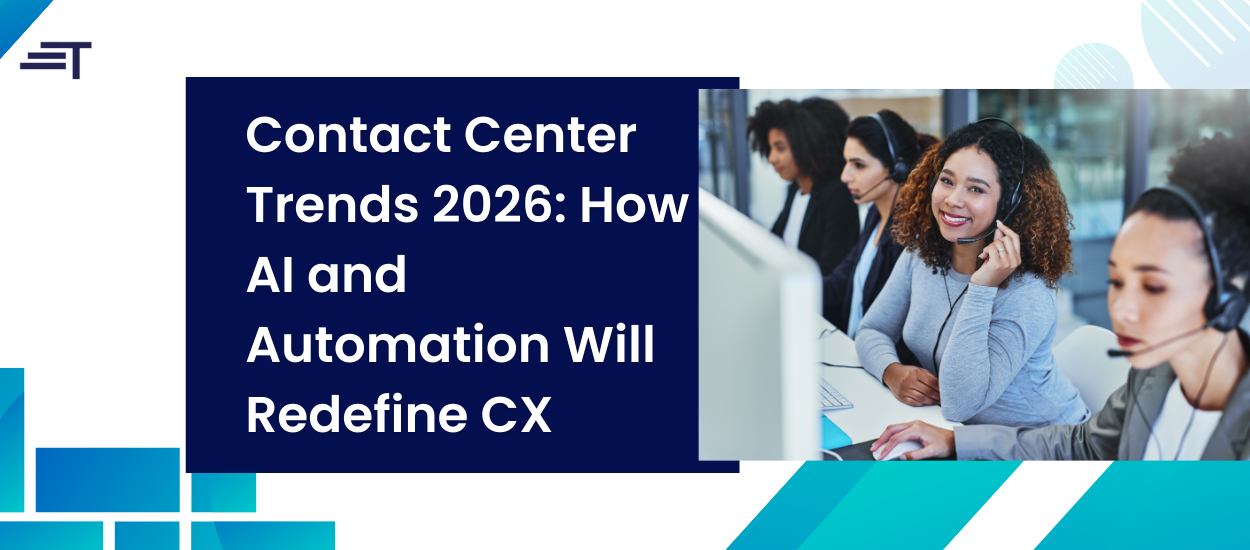
Let’s be honest — if you’re running a contact center today, it probably feels like you’re operating three different worlds at once.
One queue is overflowing with customers who want answers right now.
Another is stuck with agents jumping across five systems just to resolve one issue.
And the third? Well… no one really knows what’s happening there because the data is delayed, the workflows don’t talk to each other, and QA reviews always come in too late.
That’s exactly why traditional customer service models are breaking down in 2026 — not because your team isn’t capable, but because the infrastructure wasn’t built for modern CX.
Most legacy operations were designed for simpler times: fewer channels, predictable volumes, and reactive support.
But if you’re trying to keep up with contact center trends 2026 — faster response times, predictive support, voice AI, and unified omnichannel experiences — then AI and automation are no longer “nice to have.”
They’re the new backbone of customer experience.
And here’s how they’re redefining the future of CX in 2026.
The Top Contact Center Trends for 2026
Here are the top contact center trends:
1. AI-Powered Operations: Smarter Routing, Resolution & Workforce Automation
AI is reshaping how contact centers operate in 2026, shifting from reactive support to predictive, automated workflows. Here’s what’s driving the transformation:
-
AI-driven intent prediction now routes customers with higher accuracy, reducing AHT and improving first-contact outcomes.
-
GALE, AI Voice assistant for support, is automating 50–70% of high-volume, repetitive calls—freeing human agents for complex issues.
-
Agent-assist copilots provide real-time prompts, compliance reminders, knowledge suggestions, and sentiment cues—boosting accuracy and reducing escalations.
-
Workflow automations streamline post-call tasks, quality checks, and case creation—cutting operational costs while speeding up resolution times.
2. Unified CX: Omnichannel Support + Personalization at Scale
In 2026, the future of customer experience is defined by true omnichannel continuity—where every interaction feels seamless, personalized, and consistent across all touchpoints.
-
Unified, context-rich profiles bring together customer history from voice, chat, email, and social into one intelligent view.
-
Real-time AI personalization adapts responses, offers, and support flows instantly based on customer behavior and past interactions.
-
Predictive CX engines anticipate customer needs—triggering proactive alerts, reminders, or support before an issue escalates.
-
Eliminating channel silos improves CSAT, strengthens SLA performance, and reduces friction across the entire support journey.
3. Compliance, Predictive Analytics & Proactive CX
In 2026, compliance and customer experience are no longer separate workstreams—they’re fused into a single, AI-driven operational layer.
Here’s what that looks like:
-
Automated compliance enforcement becomes standard.
AI now handles real-time monitoring, auto-redaction, consent management, and audit-ready documentation—minimizing human error and protecting regulated industries. -
Predictive analytics spotlight risk before it becomes churn.
Advanced models evaluate sentiment, behavior patterns, and historical trends to flag high-risk customers, revenue-critical accounts, and SLA-sensitive interactions. -
Proactive CX replaces reactive firefighting.
AI triggers timely alerts, reminders, renewals, follow-ups, and support interventions—reducing inbound volume and improving customer trust.
Outcome: brands move from “responding to issues” to preventing them entirely, redefining service reliability.
Enterprise KPIs Reimagined: The ROI of AI-Driven Contact Centers
By 2026, call center digital transformation is no longer a modernization initiative — it’s a structural shift in how service organizations operate and scale. AI is changing core financial and operational metrics across the board.
-
Cost per contact is decreasing by 20–40%.
As automation absorbs routine interactions, leaders can reallocate headcount toward higher-value, revenue-adjacent work. -
Customer experience is stabilizing, not fluctuating.
Faster resolutions and fewer errors consistently lift CSAT by double digits, creating more predictable service outcomes. -
Workforce productivity is compounding.
Human–AI hybrid teams process 25–45% more volume, while reducing escalations and rework — a direct improvement to operational efficiency. -
Compliance accuracy becomes a built-in function.
Automated monitoring and audit-ready trails reduce regulatory risk, particularly in healthcare, finance, and insurance.
For executives, the implication is clear: AI is redefining the unit economics of customer operations and creating a service model that scales without proportionally increasing cost or risk.
What Future-Ready Contact Centers Must Build in 2026
Future-ready contact centers can’t rely on patched-together tools because 2026 will expose every gap. The only teams that win are the ones built on real AI-first foundations, not legacy systems pretending to be modern.
1. An AI-First Architecture
Voice bots. Agent-assist. Automation workflows.
These aren’t add-ons anymore—they’re the operating layer.
Modern contact center AI tools should handle routing, answer repetitive questions, surface insights, and keep the entire operation moving without human friction.
If your AI sits on the side, you’re already behind.
2. One Unified CX Platform With End-to-End Context
Customers bounce between channels. Your systems should keep up.
A future-ready platform pulls in everything—voice, chat, email, social, transaction history—so agents never start cold and customers never repeat information.
If your team still asks for basic details twice, the system is the problem.
3. Integrations That Don’t Break
Your contact center must connect cleanly with:
-
CRMs
-
EHRs
-
PMS
-
Billing
-
Marketing automation
-
Custom apps
If it runs your business, it should sync with your contact center without long builds or duct-tape fixes.
Scalable integrations aren’t a “nice to have.” They’re survival.
4. Security & Compliance Built for an AI Operation
AI changes how data moves. Your protections must match.
Future-ready centers need:
-
automated redaction
-
audit-ready logs
-
zero-trust access
-
real-time compliance cues
This is where legacy tools fall apart.
You need an enterprise AI platform—not a repurposed helpdesk system.
2026 contact centers will operate like cloud-first, AI-driven systems—integrated, automated, and built for scale.
Everyone else will stay stuck in firefighting mode.
2026 Transformation Roadmap: How Enterprises Can Start Today
If you want meaningful change in 2026, you can’t rely on fragmented upgrades or isolated AI experiments. You need a structured roadmap that moves your contact center from manual operations to scalable, AI-driven performance.
Here’s how leading enterprises are approaching it:
Step 1: Assess your current maturity.
Map your tech stack, workflows, data flow, and performance gaps to understand where AI will create the highest impact.
Step 2: Identify automation-ready tasks.
Spot high-volume, repetitive processes such as call routing, FAQs, ticket triage, outbound reminders, and agent-assist opportunities.
Step 3: Deploy AI tools that integrate cleanly with your ecosystem.
Prioritize solutions that work with your CRM, EHR, PMS, telephony, marketing platforms, and security framework without heavy customization.
Step 4: Roll out in phases.
Start by automating predictable tasks, then optimize based on real interaction data, and scale automation across channels as confidence grows.
Step 5: Measure what matters.
Track the KPIs that actually prove ROI: AHT, FCR, CSAT, automation percentage, cost per contact, and agent utilization.
A clear roadmap lets enterprises move fast without breaking operations—setting the stage for an AI-powered contact center that’s ready for 2026 and beyond.
Final Thoughts
Modern contact centers aren’t struggling because they lack data — they’re struggling because they can’t act on it fast enough.
And in 2026, speed will decide who delivers real customer experience and who falls behind.
You don’t need “another AI tool.”
You need a platform that connects your systems, automates the heavy lifting, and helps your teams resolve issues before they become problems.
That’s where Tollanis contact center solutions stands out.
Because the contact center that automates faster, scales smarter, and responds instantly is the one that wins.
Start building that future today with Tollanis.
FAQs
AI-driven routing, voice AI, omnichannel unification, real-time personalization, proactive outreach, and predictive analytics that reduce churn.
AI will automate repetitive interactions, shorten resolution times, enhance agent productivity, and give customers faster, more accurate, and contextual support across channels.
Lower cost per contact, faster response times, improved compliance, fewer escalations, and higher CSAT due to consistently accurate resolutions.
No. Voice AI manages high-volume, repetitive tasks so human agents can focus on complex issues, relationship building, and emotional interactions.
AI voice assistants, agent-assist copilots, unified omnichannel platforms, CRM/EHR/PMS integrations, automation workflows, and secure data management frameworks.
Most organizations begin seeing results in 6–12 weeks with a pilot approach — automating specific workflows before scaling across channels.
Yes. Modern contact center AI tools integrate with systems like Salesforce, Zendesk, HubSpot, and industry-specific platforms to ensure seamless data flow and contextual interactions.