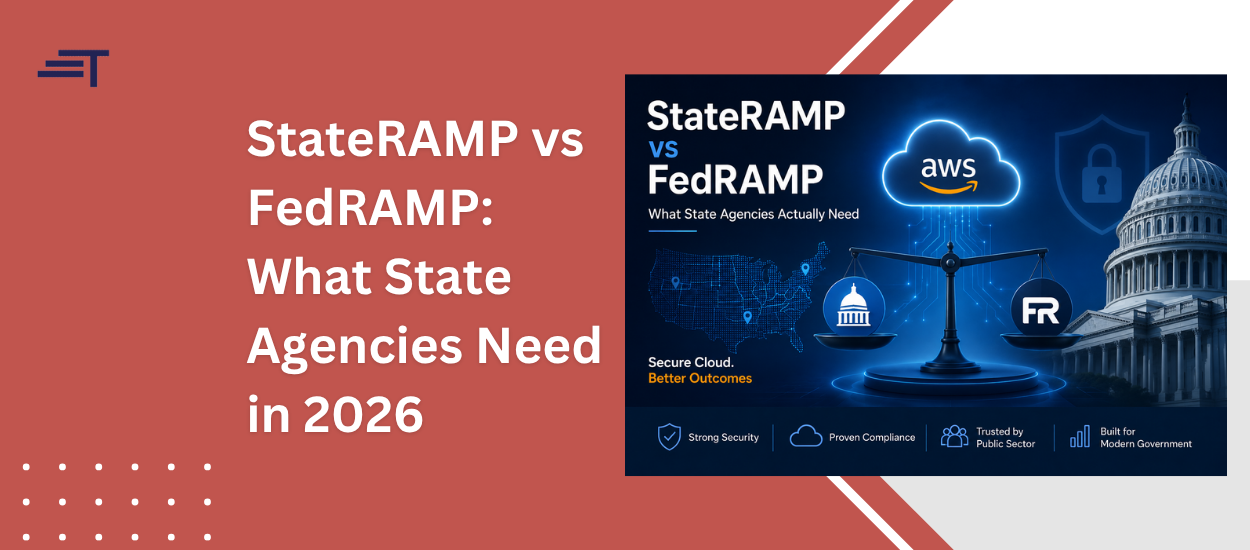
TL;DR- FedRAMP establishes security requirements for cloud services used by federal agencies. StateRAMP provides a standardized framework that helps state, local, tribal, and education organizations evaluate cloud providers. Choosing the right framework depends on your agency's procurement requirements and modernization goals.
When Every Vendor Claims They're "Compliant," How Do You Know What's Right?
Imagine you're leading a cloud modernization project for a state agency.
Your team has narrowed the search to three cloud vendors. One proudly advertises FedRAMP authorization. Another highlights its StateRAMP certification. A third claims to support both.
On paper, they all seem secure. But when procurement asks which one actually meets your agency's requirements, the room goes quiet.
If this scenario sounds familiar, you're not alone.
As state and local governments continue modernizing citizen services, choosing the right cloud technology is no longer just about features or pricing. Security, compliance, and procurement requirements now play an equally important role. Whether you're replacing a legacy contact center, deploying AI-powered customer service technology, or moving critical workloads to the cloud, understanding the difference between StateRAMP vs FedRAMP is essential.
The challenge is that these two frameworks are often confused. Many decision-makers assume FedRAMP automatically covers state government requirements. Others believe StateRAMP is simply a rebranded version of FedRAMP. Neither assumption tells the full story.
In reality, each framework was created for a different purpose, serves a different audience, and influences technology procurement in different ways.
This guide cuts through the jargon and explains what state agencies actually need to know. More importantly, it will help you make smarter technology decisions, ask the right questions during vendor evaluations, and understand how compliance fits into modern cloud solutions like cloud contact centers, AI, and digital citizen services.
In this article, we'll focus on the practical differences between StateRAMP and FedRAMP and what those differences mean when selecting technology vendors.
StateRAMP vs FedRAMP in One Minute
Need the short answer? Here's a side-by-side comparison.
|
StateRAMP |
FedRAMP |
|
Designed for state, local, tribal, and education organizations |
Designed for U.S. federal agencies |
|
Managed by StateRAMP |
Managed by the U.S. federal government |
|
Helps states evaluate cloud vendors consistently |
Standardizes cloud security for federal agencies |
|
Increasingly referenced in state procurement |
Required for many federal cloud deployments |
|
Focuses on continuous monitoring and independent assessments |
Also requires continuous monitoring and third-party assessments |
Although both frameworks are built on rigorous cybersecurity principles, they are not interchangeable.
Think of FedRAMP as the federal government's cloud security benchmark. StateRAMP extends a similar approach to help state and local governments evaluate cloud providers using a consistent framework.
The takeaway is simple: the right choice isn't about which framework is "better." It's about selecting technology that aligns with your agency's security expectations, procurement policies, and long-term goals.

Why Does StateRAMP Exist If FedRAMP Already Does?
This is one of the most common questions procurement teams ask. After all, if FedRAMP already provides a rigorous cloud security framework, why create another one?
The answer comes down to how government operates in the United States.
Federal agencies and state governments are separate entities. While they often share cybersecurity priorities, they follow different procurement rules, funding structures, and operational requirements.
FedRAMP was built specifically for federal agencies that purchase cloud services. State governments, however, needed a framework that reflected their own procurement processes while still maintaining high security standards.
That gap led to the creation of StateRAMP.
Rather than reinventing cloud security from scratch, StateRAMP builds upon many of the same security principles used in FedRAMP for state agencies. It provides a standardized approach that state and local governments can use when evaluating cloud service providers, making procurement more consistent and reducing uncertainty during vendor selection.
For agencies, this means fewer questions like:
-
Has this vendor been independently assessed?
-
How is security monitored after deployment?
-
Does this provider maintain ongoing compliance?
-
Can we compare vendors using the same evaluation criteria?
Instead of every agency developing its own cloud security checklist, StateRAMP offers a common framework that simplifies procurement while improving confidence in cloud investments.
For technology vendors, participating in StateRAMP demonstrates a commitment to meeting the security expectations of state governments. For agencies, it provides a more consistent way to evaluate risk when selecting cloud solutions.
StateRAMP vs FedRAMP: What's Actually Different?
At first glance, the two frameworks look remarkably similar. Both emphasize strong cybersecurity controls, independent assessments, and continuous monitoring. That's why many buyers assume they can be used interchangeably.
The differences become much clearer when viewed through the lens of procurement rather than technology.
1. Who They're Designed For
FedRAMP primarily serves federal agencies. StateRAMP was created to support state, local, tribal, and education organizations that need a standardized method for evaluating cloud vendors.
This distinction matters because procurement requirements often differ between federal and state governments. A vendor that satisfies one organization's requirements may still need additional documentation or approvals for another.
2. Who Uses Them During Procurement
For federal agencies, FedRAMP authorization is often a prerequisite for purchasing cloud services. For state governments, procurement policies vary by jurisdiction. Some agencies may encourage or require StateRAMP participation, while others use it as a strong indicator of a vendor's security maturity.
Rather than assuming one framework automatically satisfies every procurement requirement, agencies should always verify what their own purchasing policies require.
3. How Vendors Demonstrate Security
Both frameworks rely on independent security assessments and ongoing monitoring rather than one-time certifications. That's important because cybersecurity isn't static. Threats evolve. Cloud environments change. New vulnerabilities emerge every day.
Continuous monitoring helps agencies gain greater confidence that cloud providers maintain their security posture long after the initial assessment is complete. For procurement teams, this ongoing visibility is often just as valuable as the initial evaluation itself.
Which Framework Does Your Agency Actually Need?
Now comes the question every procurement team eventually asks: "Should we require StateRAMP, FedRAMP, or both?"
The answer depends less on the technology itself and more on who is buying it, what data is being processed, and the procurement policies that govern your organization.
Instead of thinking about StateRAMP and FedRAMP as competing frameworks, think of them as serving different government audiences.
Here's a practical way to look at it.
|
Organization |
Typical Compliance Consideration |
|---|---|
|
Federal agencies |
FedRAMP is generally required for cloud services. |
|
State agencies |
StateRAMP may be preferred or required depending on the state and procurement policies. |
|
Local governments |
Requirements vary. Many evaluate vendors using StateRAMP or comparable security evidence. |
|
Public universities |
Depends on institutional policies and the type of data being handled. |
|
Public health organizations |
Security requirements may include multiple regulatory and procurement considerations. |
|
Transportation, licensing, and public safety agencies |
Requirements differ by jurisdiction and the sensitivity of the services involved. |
The key takeaway? Don't assume one framework automatically satisfies another.
Every procurement team should verify the specific requirements outlined by its agency, state, or funding program before selecting a cloud vendor.
What Does This Mean When Buying a Cloud Contact Center?
This is where compliance becomes much more than an IT conversation.
Today's residents expect the same fast, digital experiences they receive from banks, airlines, and retailers. Whether they're renewing a driver's license, checking the status of a permit, scheduling an inspection, or contacting a benefits office, they expect quick answers across voice, chat, email, and self-service channels.
Unfortunately, many government contact centers still rely on aging infrastructure that wasn't designed for today's expectations. Modern cloud contact centers give agencies the flexibility to improve citizen experiences while supporting stronger security, scalability, and operational efficiency.
However, selecting the right platform isn't just about choosing the software with the longest feature list.
Agencies should evaluate whether a solution can:
-
Scale during emergencies and seasonal demand spikes.
-
Support omnichannel citizen engagement.
-
Integrate with existing government systems.
-
Provide detailed reporting and audit capabilities.
-
Support AI-powered self-service without compromising security.
-
Align with applicable compliance and procurement requirements.
That's why compliance should be viewed as one piece of a broader modernization strategy rather than the entire strategy.
Where AWS Amazon Connect Fits Into Government Modernization
Many government organizations are replacing legacy contact center platforms with cloud-native solutions that can adapt as citizen expectations continue to evolve.
One platform gaining significant adoption is AWS Amazon Connect, a cloud-based contact center solution built on Amazon Web Services.
Amazon Connect helps organizations deliver modern customer service through capabilities such as:
-
Intelligent call routing
-
Interactive voice response (IVR)
-
AI-powered virtual assistants
-
Omnichannel communications
-
Workforce optimization
-
Real-time analytics
-
Seamless scalability
For government agencies, these capabilities can translate into faster response times, improved accessibility, and better service delivery across departments.
It's important to note that compliance depends on the AWS environment, the services deployed, and the agency's specific procurement requirements, not simply the product name.
As an AWS partner, Tollanis helps organizations design and implement Amazon Connect solutions that align with security best practices and modernization goals. Whether agencies are replacing legacy contact centers or introducing AI into citizen support, having an experienced implementation partner can simplify migration while reducing operational disruption.
Five Questions Every Procurement Team Should Ask Cloud Vendors
A compliance badge should never be the only factor influencing your decision. During vendor evaluations, ask questions that reveal how well a provider can support your agency over the long term.
1. Which security authorizations and assessments do you currently maintain?
Look beyond marketing claims. Ask vendors to explain how their security posture is independently validated.
2. How do you support continuous monitoring?
Security isn't a one-time event. Ongoing monitoring helps agencies stay ahead of evolving cyber threats.
3. Can your platform integrate with our existing government systems?
A modern contact center should connect with CRMs, case management systems, identity platforms, and other critical applications.
4. How will AI be governed?
If AI-powered features are included, understand how data is protected, how models are managed, and what controls are available.
5. What experience do you have supporting government modernization projects?
Technology matters, but implementation experience often determines whether a project succeeds.
Final Thoughts
The conversation around StateRAMP vs. FedRAMP isn't really about choosing one framework over another.
It's about making informed technology decisions that balance security, compliance, operational efficiency, and citizen experience.
As state agencies continue modernizing digital services, procurement teams need more than a checklist of certifications. They need technology partners who understand government requirements, cloud security, and how to deliver exceptional customer experiences at scale.
Whether you're evaluating a new cloud contact center, planning an AI initiative, or replacing legacy infrastructure, understanding how compliance fits into your broader modernization strategy will help you make smarter long-term investments.
As an AWS partner, Tollanis helps organizations modernize customer service with Amazon Connect, enabling secure, scalable, and AI-powered contact center experiences tailored to each agency's operational and procurement needs.
The future of government service isn't just more secure. It's faster, smarter, and built around the people who rely on it every day.
Frequently Asked Questions (FAQs)
FedRAMP focuses on cloud services used by U.S. federal agencies, while StateRAMP provides a standardized security assessment approach for state, local, tribal, and education organizations.
No. Requirements vary by state and agency. Procurement teams should review their organization's purchasing policies before selecting a cloud vendor.
Yes. Some cloud providers pursue both programs to support customers across multiple levels of government.
Not necessarily. While FedRAMP demonstrates a strong security posture, some state agencies may have additional procurement or security requirements.
Compliance helps agencies evaluate how cloud providers manage security, risk, and continuous monitoring. It should be considered alongside scalability, integrations, AI capabilities, and overall citizen experience.
Amazon Connect is used by many public sector organizations through appropriate AWS services environments and configurations. Agencies should evaluate deployment options against their own compliance, security, and procurement requirements.