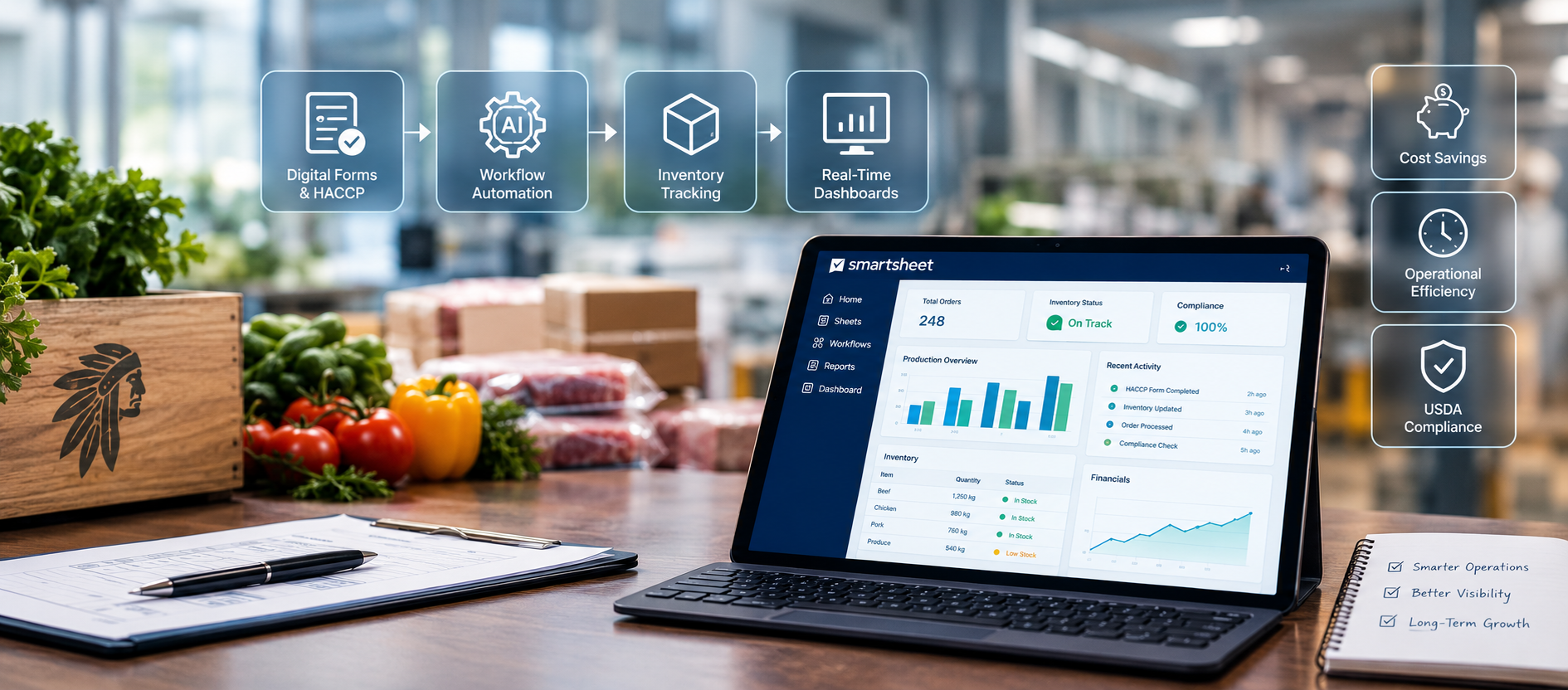
A growing food production and distribution organization relied heavily on manual, paper-based processes for operational management, HACCP logging, order processing, and inventory tracking.
Fragmented workflows, inconsistent data, and dependence on tribal knowledge created operational inefficiencies and increased training requirements. Existing Smartsheet workflows offered a temporary digital solution but were approaching their functional limits.
Tollanis developed a phased digital transformation strategy combining Smartsheet-based automation with ERP evaluation to improve operational efficiency, strengthen compliance tracking, and establish a scalable foundation for long-term growth.
COMPANY TYPE |
INDUSTRY |
SUPPORT MODEL |
ENGAGEMENT TYPE |
|
Food Production & Distribution |
Food Manufacturing |
Digital Transformation & Automation |
Workflow Automation & ERP Strategy |
The organization's operational processes depended on paper records, desktop spreadsheets, and employee-specific knowledge, limiting efficiency and data reliability.
Key challenges included:
Manual HACCP logging and operational documentation.
Fragmented order processing and inventory tracking.
High training overhead due to dependence on tribal knowledge.
Smartsheet workflows approaching their functional limits.
Disconnected compliance, reporting, and automation processes.
Limited real-time visibility into inventory and financial performance.
The organization needed a practical digital transformation roadmap that balanced affordability and immediate operational improvements with long-term ERP scalability.
Tollanis developed a phased digital transformation strategy, using Smartsheet to address immediate operational needs while evaluating ERP platforms for long-term sustainability.
Digitized HACCP forms and operational records.
Introduced AI-assisted workflows.
Enabled tablet-based data entry to reduce paper-based processes.
Connected digital records with automated workflows.
Introduced barcode-based inventory tracking.
Developed real-time financial dashboards.
Improved operational and inventory visibility.
Tollanis evaluated 12 ERP vendors to identify a solution aligned with the organization's operational requirements, budget, and future growth plans.
Based on the assessment, Food Connex (CAI) was recommended for its catch-weight support, QuickBooks integration, and scalability. SYSPRO and Aptean were identified as alternative options for future consideration.
The phased transformation strategy establishes a foundation for reducing manual work, improving data accuracy, and connecting operational processes.
Key anticipated business benefits include:
These benefits represent estimated or intended outcomes; realized savings and post-implementation performance have not yet been validated.
Tollanis helped establish a practical roadmap for modernizing food operations without requiring an immediate, large-scale ERP transition.
By combining Smartsheet automation, digital HACCP documentation, barcode-based inventory tracking, financial dashboards, and an ERP readiness assessment, the organization has a structured path toward greater operational efficiency and visibility.
The strategy balances immediate process improvements with long-term technology planning, helping the organization prepare for scalable operations and more data-driven decision-making.
30 Sep 2026

28 Sep 2026
9 Aug 2026

9 Aug 2026

9 Aug 2026

21 Jul 2026

15 May 2026

5 May 2026

5 May 2026

4 May 2026

4 May 2026

30 Apr 2026

9 Jan 2026

31 Dec 2025

31 Dec 2025

27 Oct 2025

2 Oct 2025

2 Oct 2025

18 Sep 2025

2 Sep 2025

21 Jul 2025

21 Jul 2025

21 Jul 2025

21 Jul 2025

21 Jul 2025

4 Feb 2025

4 Feb 2025
